
RTF Surface Jointmeter
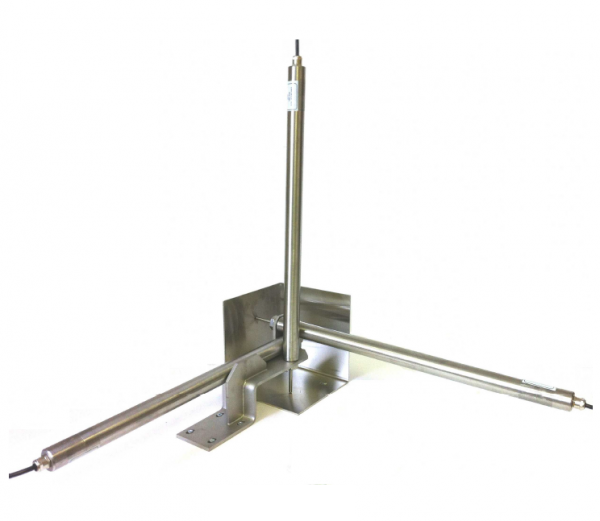
The RTF is a jointmeter used to measure the displacement of cracks in structures or rock masses. The RTF is available in uniaxial (RTF 1D) and triaxial (RTF 3D) versions.
DESCRIPTION
The RTF surface jointmeter (also crackmeter or fissurometer) is designed to monitor relative movements of adjacent surfaces across cracks or construction joints.
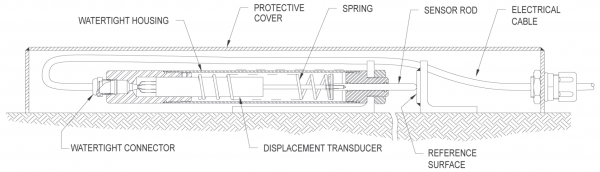
The RTF surface jointmeter consists of a vibrating wire transducer or a potentiometer, and a set of mounting brackets.
The RTF surface jointmeter is available in uniaxial (RTF 1D) or triaxial (RTF 3D) versions. The 3-D version allows simultaneous measurements in three orthogonal directions.
The sensor is housed in a rugged cylindrical enclosure which is end fitted with a spring-loaded rod. The bracket containing the transducer(s) is mounted on one side of the discontinuity and the bracket fitted with the reference surface(s) is mounted on the opposite side of the discontinuity. The spherical tip of the spring- loaded rod rests against the reference surface.
The RTF is easily bolted astride the joint or crack. On uneven surfaces, brackets welded to short lengths of rebar are used.
SPECIFICATIONS
TRANSDUCER :
VIBRATING WIRE
POTENTIOMETER
Ranges1 :
252 – 502 – 1002 – 150 – 200 mm
25 – 50 – 100 – 150 mm
Accuracy1 :
±0.25% F.S. (±0.1% in option)
±0.5% F.S
Resolution :
0.02% F.S.
Depends on readout
Operating temperature :
−20 to +80°C
−20 to +80°C
Thermistor :
3kΩ (see model TH-T)
—
Readout instruments :
MB-3TL, SENSLOG
Contact Roctest
Cable :
IRC-41A(P)
IRC-41A(P)
1 Other ranges and accuracies available upon request.
2 3D available for these ranges only.